
Zip Screens
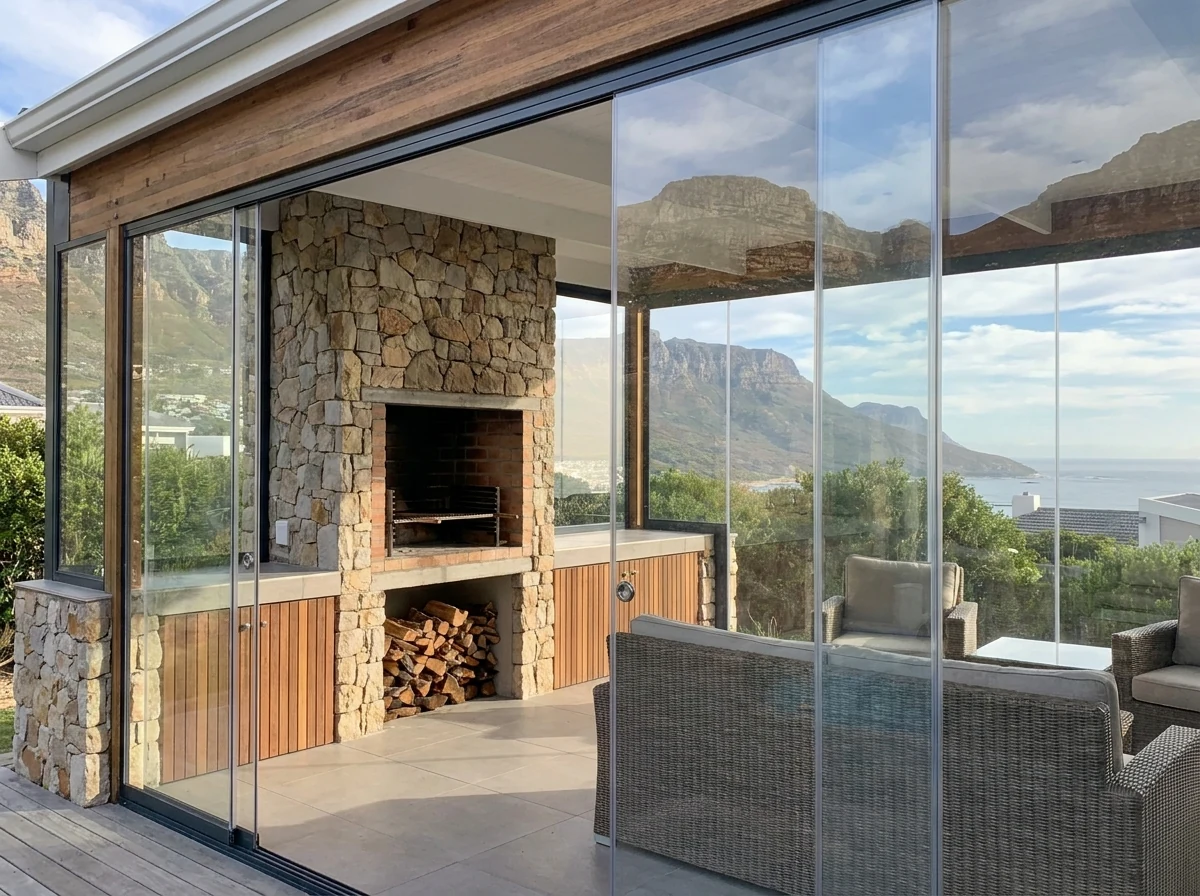
The product that turns an exposed deck into an outdoor room — mesh or clear PVC, locked tight in aluminium side channels so it holds against real coastal wind instead of flapping loose.
The zip difference
The fabric edge is welded into a zipper that runs captive inside aluminium side channels — no flapping, no gap at the edge, real wind resistance. An ordinary drop screen escapes its guides in exactly the conditions this coast produces regularly; a zipped screen holds tension through them. That's the whole argument for specifying this over a plain roll-down screen anywhere near open water.
02Mesh or clear, depending on the job
Sunscreen mesh keeps the view out while cutting glare, UV and insects, with daytime privacy as a side benefit. Clear PVC panels seal the same opening against wind and rain while keeping it fully transparent — the choice for a winter braai room where you still want to see the water. Blockout panels exist too, for an outdoor cinema wall or a hard west-sun opening that needs a harder stop.
03Specified for two-directional wind, not one
Because this coast takes both the summer south-easter and winter cold-front north-westerlies, we motorise as standard on any span over a couple of metres and fit a wind sensor for auto-retract on exposed positions — Gansbaai's open decks and Kleinmond's wind-funnel patios both call for it. Channel colour is matched to the structure, not left as an afterthought.
- Zipped edges hold tension where a drop screen flaps or escapes its guides
- Mesh, clear PVC or blockout fabric depending on the room's job
- Motorised with wind-sensor retract standard on exposed spans
One honest limit
A zip screen manages wind and glare; it is not a permanent building enclosure. On the most exposed decks — Gansbaai's harbour-front and Kleinmond's estuary mouth in particular — we'll tell you honestly if a span is beyond what any fabric screen should be asked to hold, rather than oversell it.
What to budget for zip screens
Zip screens are guided by the square metre of screen, installed. Hand-operated, budget R2,800 to R4,500; motorised with wind-sensing control, budget R4,000 to R6,000. Behind the premium over an ordinary outdoor blind sit the zipped channel and the sealed head — the parts that hold the fabric under tension when a south-easter comes across the bay instead of letting it flog itself apart.
A stoep is usually several narrower bays rather than one huge screen, and a narrow bay is priced to a minimum rather than strictly by area. Fabric choice moves the number too: an open mesh that keeps the water in view and a solid panel that closes the space in properly are not the same money. Every bay is measured free of charge and then priced on its own line in writing.
Any exposed deck or patio qualifies, but Gansbaai's harbour-front and Kleinmond's wind-funnel positions are where a zip screen earns its keep the fastest.
Turn your deck into an outdoor room
Free in-home measure, a full written quote, no obligation.
Book your free measure