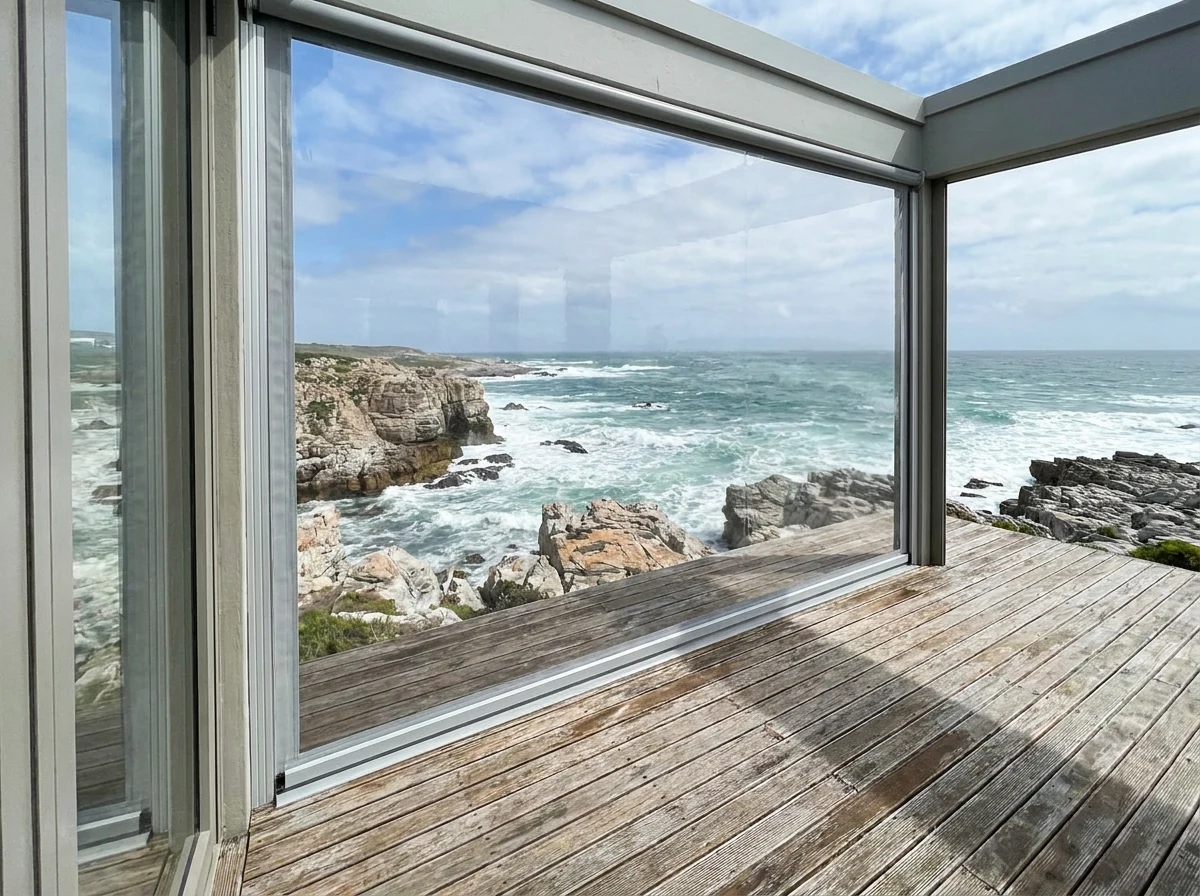
Drive this coast from Kleinmond to Gansbaai and the shoreline turns almost ninety degrees under you. Nobody mentions it, because from the road it is all just sea. But it means a lounge in Onrus and a lounge in De Kelders — both facing open water, both with the same big window — have opposite problems and want opposite answers. This guide is about working out which of the three you have before anyone quotes you.
Most of South Africa's coast runs in a reasonably predictable direction for a long way, and people build a rule of thumb around it. Here, that rule of thumb breaks inside forty kilometres.
The western end of our patch sits on Sandown Bay, where Kleinmond lies at the mouth of the Bot River lagoon with the Kogelberg mountains rising immediately behind the village.1 Carry on east through Hawston, Vermont and Onrus and you are on the northern edge of Walker Bay, with Hermanus a little further along the same shore.2 Every one of those towns looks out at water lying to the south of the house.
Then the bay curls. Follow it round and you come out on the far side at De Kelders and Gansbaai, which sit on the eastern shore of the same Walker Bay looking back west and north-west across it — the water between them and Hermanus is the water they see from the lounge.2 And twenty-odd kilometres inland, Stanford sits on the Klein River with no sea in the picture at all.3
That is the whole of this guide in one paragraph. The sun in the southern hemisphere travels across the northern part of the sky and sets in the west. So on the south-facing shore, the sun never crosses your water. On the western shore, it crosses it every single afternoon and then sets into it. Same coast, same product catalogue, completely different brief.
Ask an owner which way the house faces and they will usually say “the sea”. On this coastline that is not an answer.
Part two
Water to the south: Kleinmond, Onrus, Vermont
If your good glass looks south over the water, you have the gentler of the two coastal problems, and it is the one most often mis-specified — usually by treating it as a heat problem when it is not.
Direct sun barely touches a south elevation here between about March and September, and even in high summer it is confined to the first and last hour of the day. So the room is not being cooked. What it is being flooded with is indirect light: a bright southern sky and a large sheet of moving water underneath it, both of which are throwing daylight in at you all day. The room reads as glary, the television washes out, and the horizon you paid for goes hazy behind the reflection of your own furniture.
The second thing a south wall gets here is weather. Winter on this coast arrives as north-westerly frontal systems off the Atlantic, and the rain that comes with them is driven, not vertical.4 Anything fitted outside on an exposed west or south-west corner will spend the winter wet, which is a hardware question rather than a fabric one.
What we would fit on the south side
Sunscreen roller blinds, 3–5% openness. They cut the diffuse brightness and the ultraviolet without deleting the water. Where the view is the whole reason for the room, a darker fabric tone on the room side gives noticeably cleaner view-through than a white one, because a pale weave bounces daylight back at you.
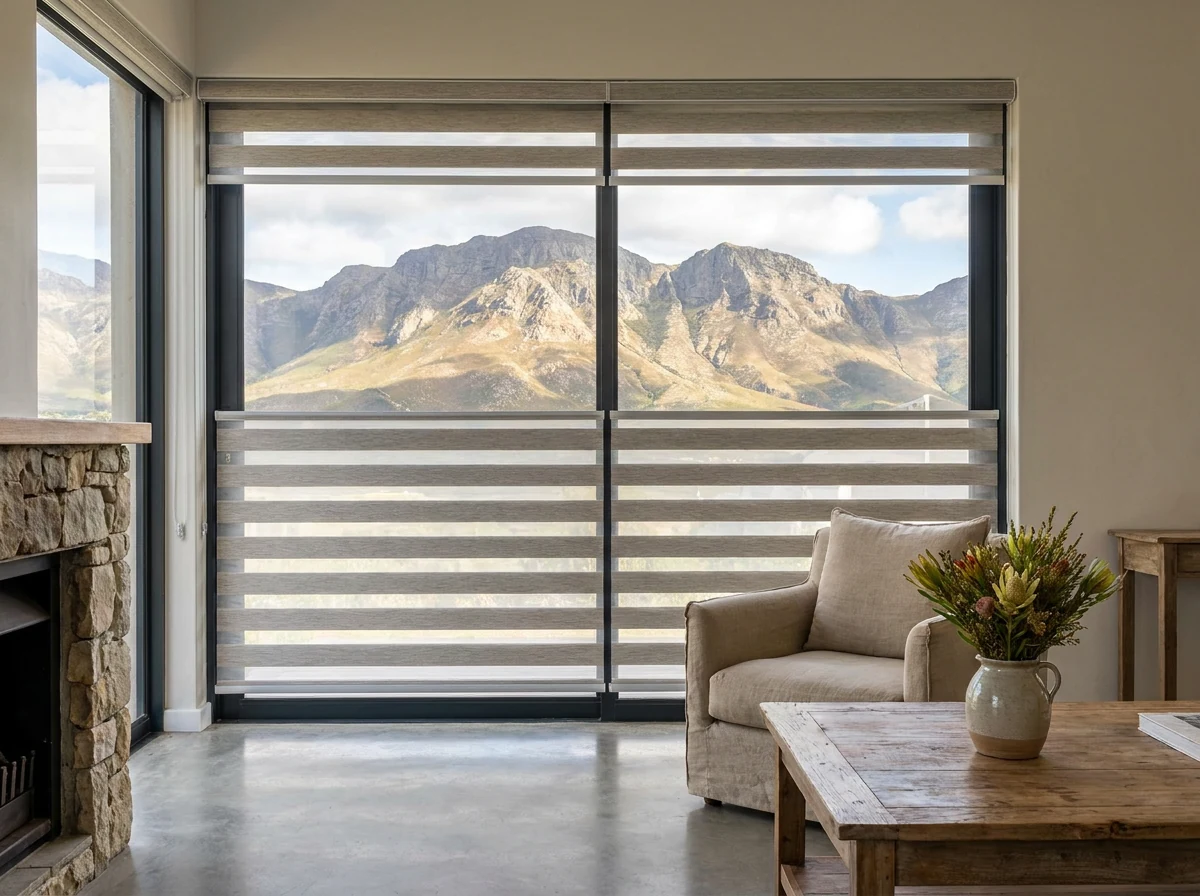
Day and night banded blinds where the room needs to change during the day — open bands for the morning, aligned solid bands for privacy once the lights go on inside and the street can see in.
Cellular honeycomb blinds in the cold rooms. A south room with no direct sun and a single-glazed pane runs cold in July. The pleated cells hold still air against the glass, which is the only thing on a blind order that measurably warms a room.
Straight about it: a mesh that kills all the glare will also dull the view, and one that keeps the view perfect will leave some glare. There is no fabric that does both. We will show you two samples on your own window rather than argue about it in a showroom.
Kleinmond — bands offset so the mountain stays visible through the sheer while the solid strips take the edge off the sky.Part three
Water to the west: De Kelders and the Gansbaai side
Now cross the bay. A window at De Kelders or above the Gansbaai harbour is pointed at the same body of water, but the sun spends its whole afternoon travelling over it and then, in high summer, sets well to the south of due west — which from this shore is straight down the length of the bay.
The effect is not a little worse than the south-facing case. It is a different category of problem. You get the direct beam at low angle, arriving at seated eye height where no roof overhang can help, and you get a second helping of the same beam bounced off the water surface. The room heats late in the day, when it has already been absorbing warmth for hours, so the peak discomfort lands at exactly the hour people want to sit in it.
An interior blind cannot fix that properly, and it is worth understanding why rather than taking our word for it. Once sunlight is through the pane, the energy is in the room. A blind behind the glass absorbs it, warms up, and re-radiates the heat inwards; it improves the glare and does comparatively little for the temperature. Stop the beam before the glass and the pane never warms up at all. That is why the premium end of the range on this shore lives outside the building.
The premium answer for a west-facing coastal room
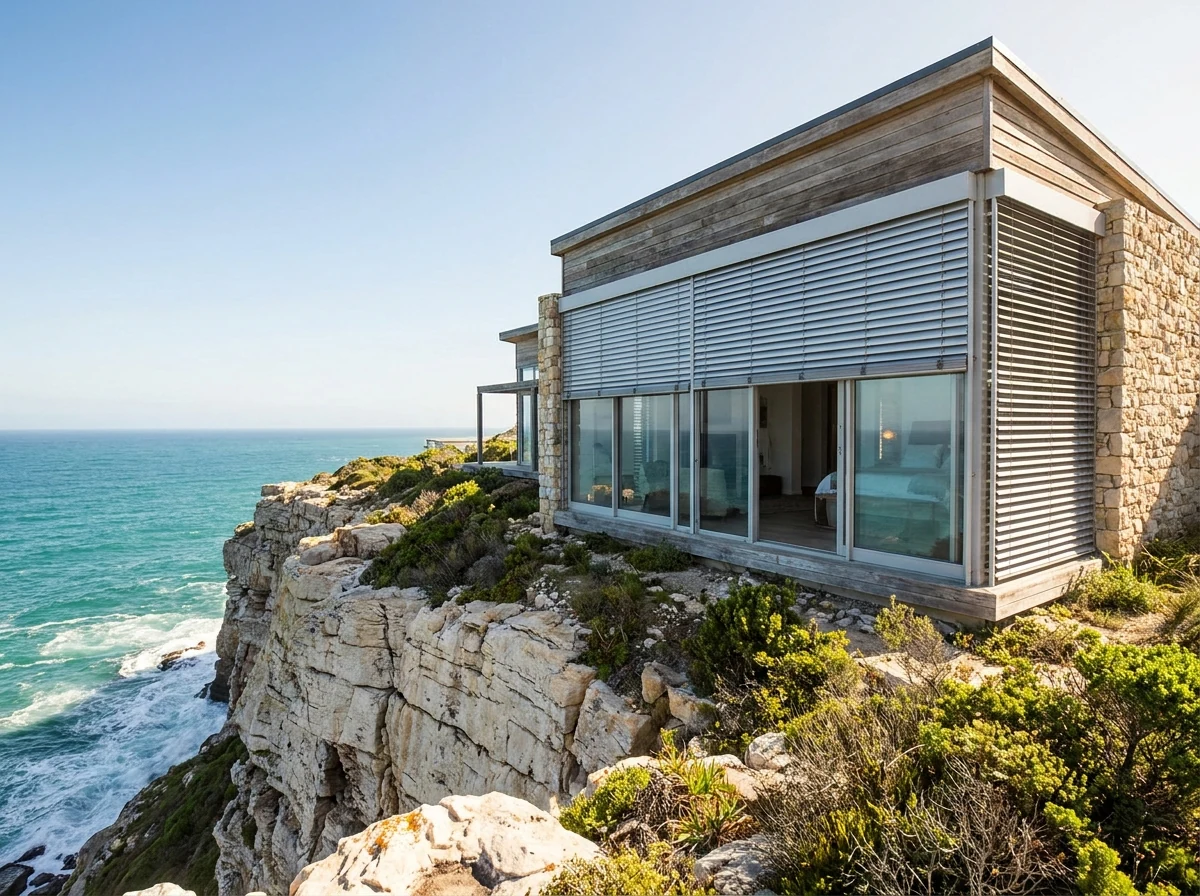
External venetian blinds where the view is precious. Aluminium slats mounted clear of the pane, tilting rather than simply dropping, so you can deflect a low sun off the water and still see the boats. They lift right out of the way for the months you want every hour of light.
External roller shutters where the room needs the heat stopped hard — rigid slats closing over the opening, plus an insulating air gap on a cold night. One clarification, since the word gets used loosely: what we supply manages sun, heat and glare outside the pane and holds no security rating whatsoever. Security shutters are a separate product and a separate conversation.
Zip screens for a deck or a stoep that is currently unusable after four o'clock. Tensioned mesh running in aluminium side channels shades the outdoor room and, incidentally, is the only outdoor shade on this coast that behaves in a real wind.
The trade-off: anything external costs more, wants something solid to fix into, and stands a working mechanism out in salt air where it will need attention. Part five deals with that honestly. Where the building genuinely cannot take an external fitting, a low-openness sunscreen inside is the fallback — better than nothing, clearly weaker on heat.
De Kelders — the slats are outside the glass, which is the entire point: the pane behind them never gets warm.Part four
No water at all: Stanford and the river villages
Twenty minutes inland from the coast road and the entire specification relaxes. Stanford sits on the Klein River, a village laid out in the eighteen-fifties whose old core is still largely made up of nineteenth-century cottages.3 There is no salt aerosol to speak of, the wind arrives already broken up by the ground it has crossed, and the nights get properly cold in a way they do not on the beach.
Three practical consequences:
Materials that are wrong on the coast come back into play. Timber venetian slats, which we would talk you out of on a Gansbaai harbour window, are entirely at home in a Stanford room. Natural fibres and unsealed finishes last here in a way they do not within sight of surf.
The problem shifts from heat to cold. High-ceilinged old cottages with single glazing lose warmth through the glass all night. Cellular honeycomb blinds do more for one of these rooms than any amount of sun control.
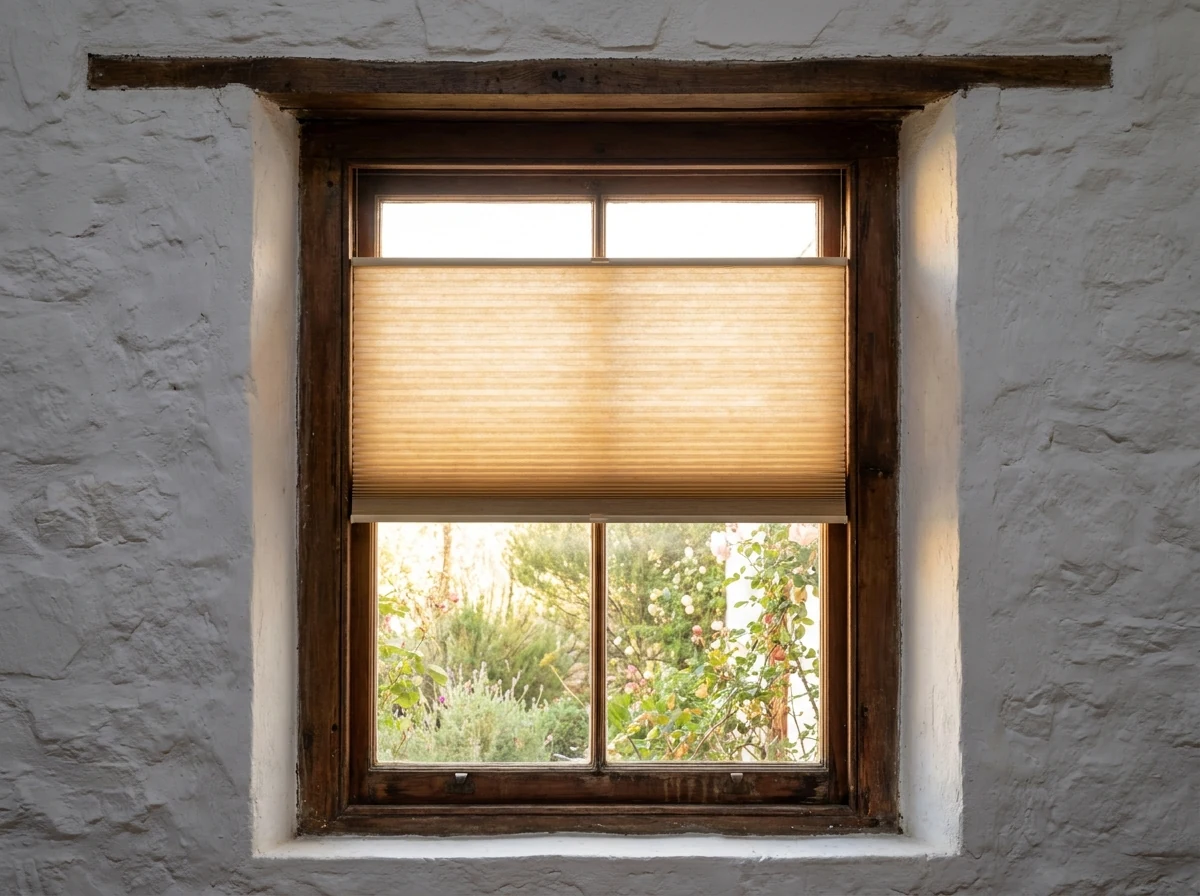
Small, deep, original openings change the fitting. Thick walls give a generous reveal, which means a blind can sit fully inside the opening, in shadow, touching nothing on the outside face of the building. On an old cottage that is both the best-looking answer and the least complicated one.
Stanford — inside the reveal of a village cottage window, where the honeycomb is working against a cold night rather than a bright sea.Part five
Metres from the surf beats the name of the town
People ask us whether their town is a “salt town”. It is the wrong unit. What decides how hard the air is on hardware is how far you are from breaking water, how much stands between you and it, and how often the wind blows off the sea rather than across it. A front-line house at Gansbaai and a house six streets back in the same town are not on the same maintenance schedule.
What we specify as standard everywhere on this coast: powder-coated aluminium on external components, sealed cassettes, and fasteners chosen for a marine environment rather than for the invoice. What we will also say plainly, because most quotes do not:
No finish makes maintenance unnecessary on the front line. An occasional rinse with fresh water from a garden hose — not a pressure washer, which drives salt into the seals — extends the life of exterior hardware more than any upgrade you can buy. It matters most in the days after a hard blow.
Good stainless still marks. A brown surface bloom on coastal fixings is cosmetic. It wipes off. It is not the bracket giving up.
Motors and controls are the costly part to replace. Where a run of glass has a sheltered end we put the drive there, and we pay attention to the cassette seal and the cable entry rather than assuming the coating will do all the work.
Interior hardware is not exempt in a house that lives with its doors open. Aluminium in the kitchen and the bathroom; save the timber for the dry rooms and the inland houses.
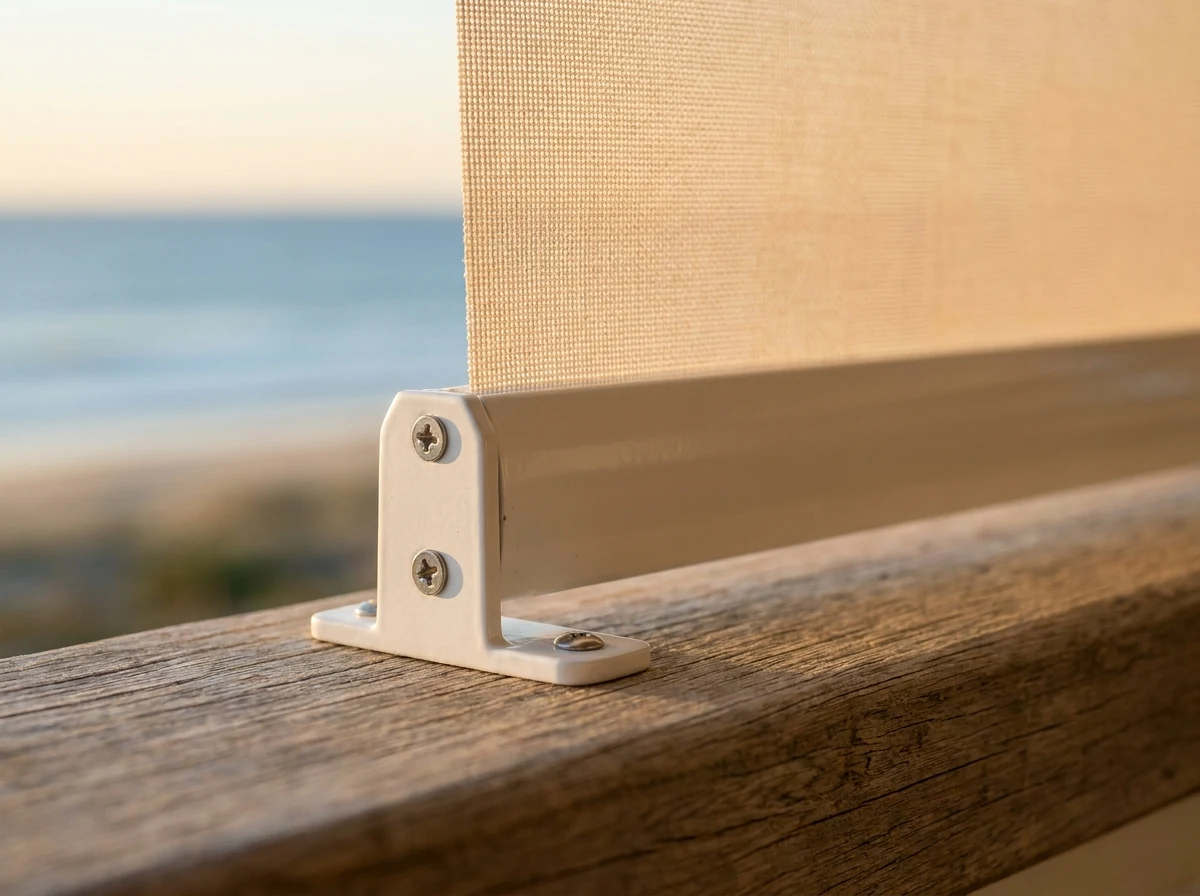
The small metal parts are what the coast actually attacks — the bracket, the fastener, the joint — long before the fabric shows anything.Part six
The mountains do not stop the wind, they aim it
The defining feature of this stretch is that the mountains come almost all the way down to the water. Behind Kleinmond it is the Kogelberg; behind Hermanus and Stanford the Kleinrivier range. It looks like shelter and people assume it is.
It is not, quite. High ground does not absorb a wind, it redirects and compresses it, which is why a valley mouth, a saddle between two hills or a gap behind a village can be reliably windier than the open beach a kilometre away. On this coast the summer south-easter and the winter north-westerly fronts both arrive with terrain in the way,4 and the result is that exposure here is a property of the individual site rather than of the town.
Which is why we will not quote outdoor shading off a photograph. Two things we hold to on every exterior job along this shore:
Automatic retraction on anything that projects. A wind sensor pulls an awning in before the gust arrives, and it does that when nobody is home — which is when the expensive version of this event usually happens.
Channels beat arms once a site is genuinely exposed. A zip screen held in side channels passes wind load into the building down its whole height. A folding-arm awning carries it in two elbows. Both are good products; on an exposed deck the difference is decisive.
And the plain fact under both: a fabric shade is a convenience you can withdraw, not a piece of structure. On this coastline, whatever cannot be withdrawn will eventually meet a wind that withdraws it for you.
Gansbaai — the fabric is held on both edges rather than hanging free, which is the only reason a screen this close to the rocks stays flat.Part seven
What you are allowed to bolt to the outside
Everything in part three hangs on the outside of your building, so it is worth knowing in advance who else gets an opinion.
Old buildings
The sixty-year line in the National Heritage Resources Act catches more buildings on this coast than owners expect. Cross it and external work on the building, or on any part of it, becomes something the provincial heritage resources authority has to permit first.5 That sweeps in a large share of Stanford's village core and a fair number of older cottages along the coast. The distinction is simple: a blind fitted inside the reveal alters nothing and needs nobody's permission. A headbox, guide channel or cassette fixed to the outside face of the wall is an alteration, and the time to raise it is before the order rather than on installation day.
Conservation areas and estates
The western end of this coast falls inside the Kogelberg Biosphere Reserve, which UNESCO registered in 1998 as South Africa's first.1 A biosphere designation is not in itself a rule about your window, but it sits alongside local planning and environmental controls, and several coastal developments here run their own architectural guidelines about what may show on an elevation. Those private rules are often stricter than anything statutory.
Our job is to make the request easy to say yes to: slim profiles, quiet colours, a drawing set, product data and a written specification you can hand straight across the table. Our job is not to promise you the answer, and we do not put in applications under anybody else's name.
Part eight
Three things we cannot answer from the road
The rest of this you can work out with an atlas and a little candour. These three you cannot, and they are why the measure is free, unhurried, and done at your window rather than down a phone line.
Your actual exposure, as opposed to your town's. A deck tucked behind a dune and a deck on an open corner two streets away are different wind jobs with the same address. We stand on it, look at what is upwind, and spec from that.
What is behind the plaster, and whether it will hold a fixing. Solid masonry, cavity brick, later stud work or a boarded parapet decide whether an external product can hang there at all — and no photograph shows this.
Every reveal, measured at three heights. Old openings move and new ones are not always square. Ten millimetres is the difference between an inside fit and a face fit, and the two look nothing alike.
All three cost nothing to check now and a great deal to discover afterwards. That is the whole case for a visit.
Next step
Have the second half of this conversation at your own window
Tell us which town you are in, which way the good glass faces and which room is the problem. One of our expert consultants will contact you shortly to arrange a free in-home measure with fabric and slat samples, followed by a written per-window quote.
→
An exposure read, not a guess
We look at what stands between your window and the water before we recommend anything that hangs outside.
→
Nothing priced sight-unseen
Every quote follows the measure, itemised per window, with the trade-offs written down rather than glossed over.
Sources
Where the checkable parts come from
The geography and the law above trace to these. The product recommendations and the fabric opinions are ours, offered free and without obligation, and they are opinions rather than findings.
Wikipedia — Kogelberg Biosphere Reserve (the reserve around Kleinmond and the Kogelberg mountains, registered by UNESCO in 1998 as South Africa's first biosphere reserve).
Wikipedia — Walker Bay (the bay's shape and its two shores — Hermanus and the Onrus side to the north-west, De Kelders and Gansbaai to the south-east — which is the geography the whole of this guide rests on).
Wikipedia — Stanford, Western Cape (the village's position inland on the Klein River, its founding in the eighteen-fifties and its surviving nineteenth-century village core).
South African Weather Service — weather and climate information (the winter-rainfall regime of the south-western Cape, arriving as north-westerly frontal systems, and the summer south-easterly pattern referred to in parts two and six).
SAFLII — National Heritage Resources Act 25 of 1999, section 34 (the permit requirement from the provincial heritage resources authority before altering a structure, or part of one, older than sixty years).
Nothing on this page is a heritage or planning approval, an environmental opinion or a wind-load calculation for your building. Those belong to Heritage Western Cape, your local authority and a suitably qualified professional.